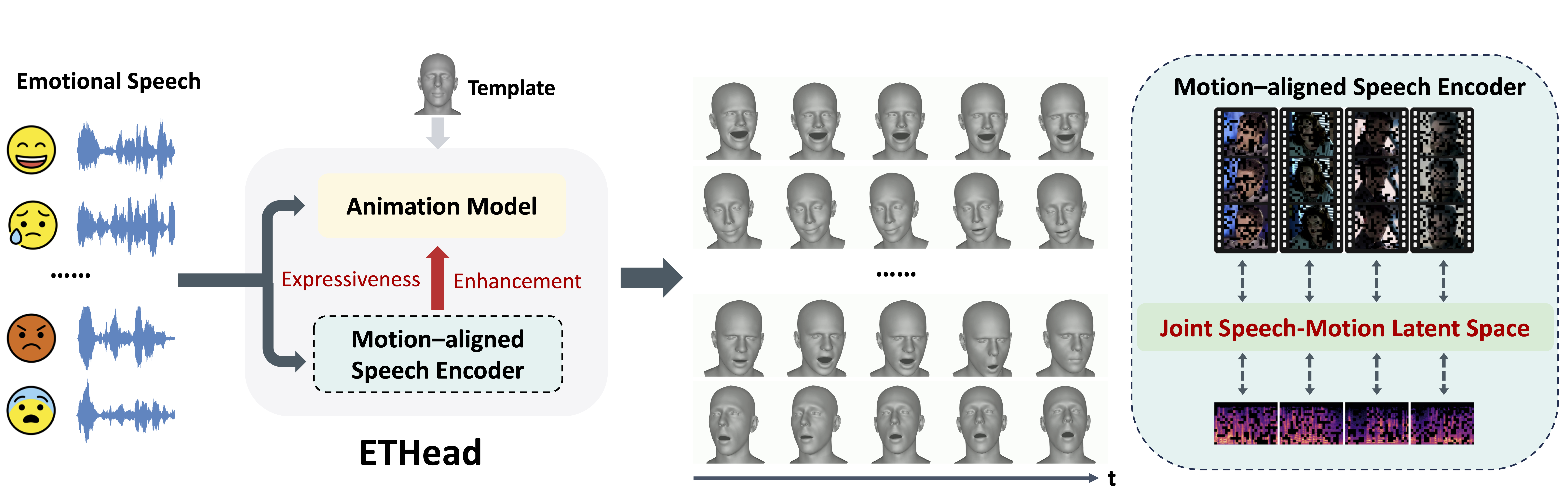
Generating expressive 3D talking heads solely from speech remains a significant challenge due to the scarcity of high-fidelity 3D data, which limits the modeling of complex emotional motion patterns. In this paper, we introduce Expressive Talking Head (ETHead), a method for generating 3D facial and head motions that vividly align with the emotional content of input speech. To overcome the data limitations, we design a self-distillation framework that leverages large-scale 2D talking videos to pre-train a specialized speech encoder. By incorporating a novel emotion-modulated probabilistic masking mechanism, this framework aligns speech representations with expressive visual dynamics, allowing the encoder to extract features highly correlated with facial and head motions directly from audio. These features are then leveraged to guide 3D generation, enriching input cues and providing explicit supervision through a joint speech-motion latent space. Extensive experiments demonstrate that ETHead substantially outperforms state-of-the-art methods. Furthermore, our motion-aligned speech encoder can serve as a transferable module, offering a general solution for enhancing expressiveness in other 3D talking head animation frameworks. The source code will be publicly released.
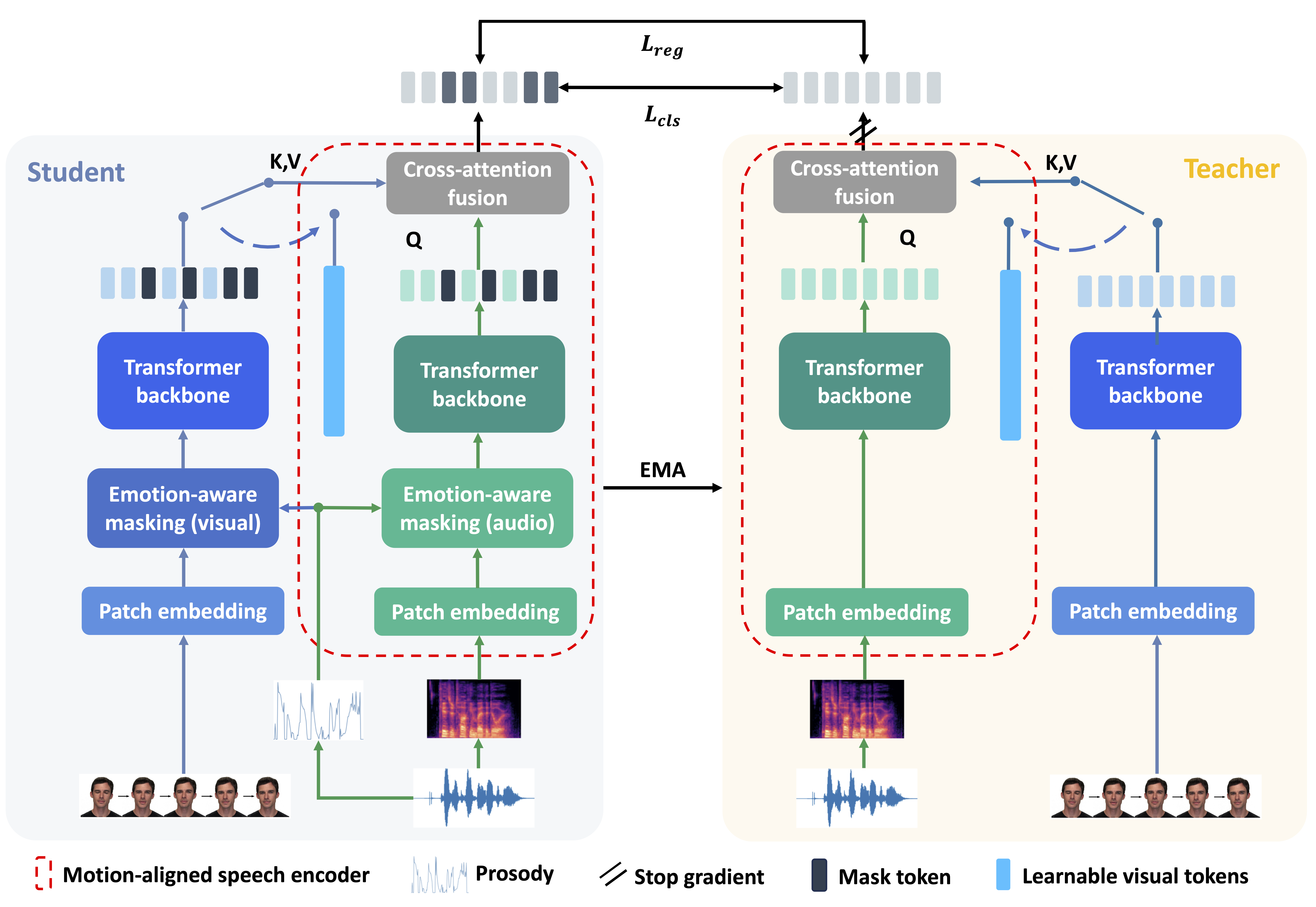
Training framework of the motion-aligned speech encoder. Given a talking head video clip, the Student and Teacher networks separately extract modality-specific features followed by intra-network fusion. Random temporal masking is applied exclusively to the Student's features, specifically targeting segments with intense emotional dynamics identified by prosody variations. The visual tokens are randomly dropped and replaced with learnable tokens. The training is driven by two self-distillation objectives: Lcls aligns category predictions, while Lreg reconstructs fused tokens at masked positions.
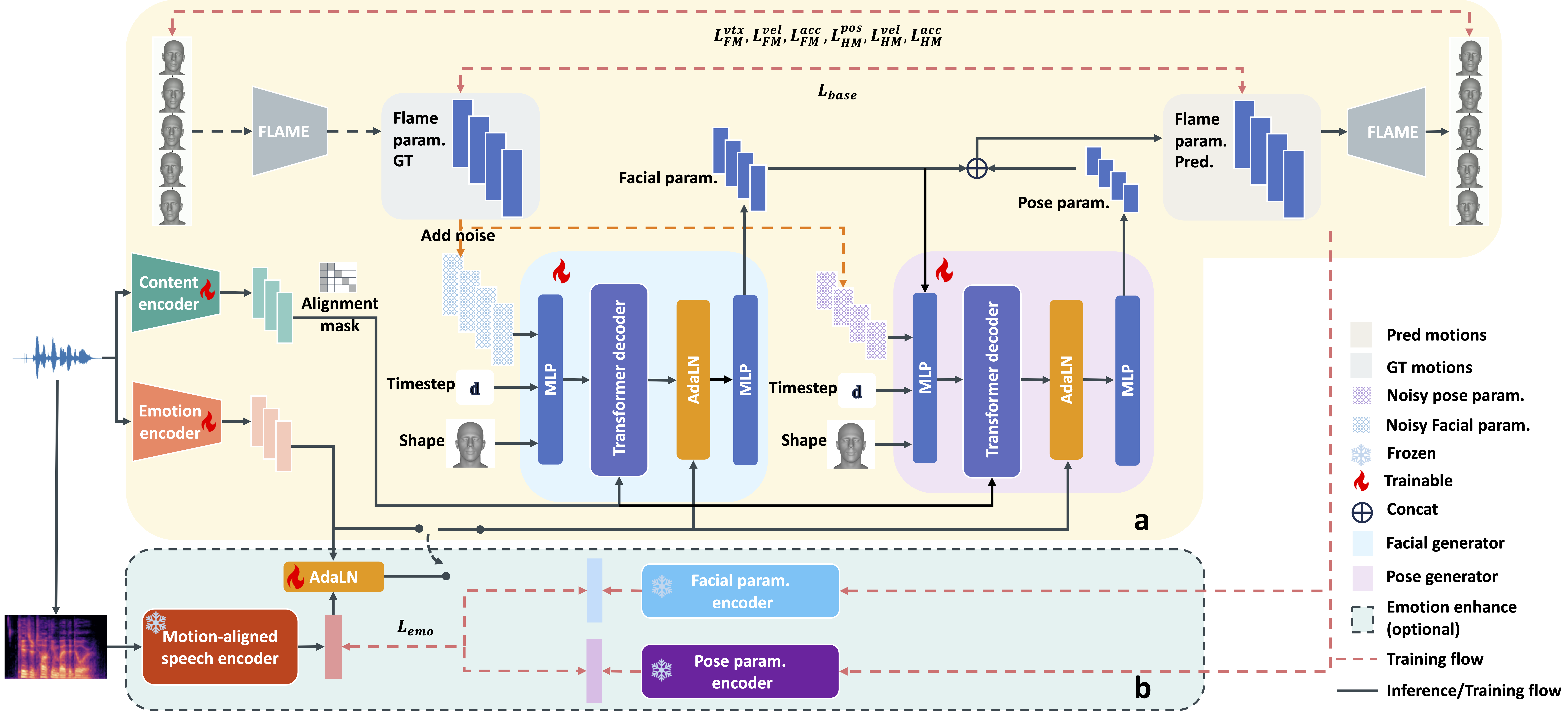
Overview of the proposed framework. (a) Generation Pipeline: The model extracts linguistic content and emotional features from input speech to condition two diffusion-based generators. In a cascaded manner, synthesized facial motion parameters are combined with speech features to drive the subsequent head motion generator. Training is supervised by reconstruction and kinematic consistency objectives. (b) Auxiliary Module: An optional motion-aligned speech encoder enhances the baseline through input feature modulation and output-level supervision within a pre-trained speech-motion latent space.
@article{ethead2026,
  title={ETHead: Generating Expressive 3D Facial Animation and Head Movement from Speech},
  author={Xie, Jiu-Cheng and Zheng, Jiwang and Xia, Yongkang and Xiong, Jian and Pun, Chi-Man and Gao, Hao and Xu, Feng},
  year={2026}
}